Honey Purity Tests, Explained
How to Test Honey Purity at Home (And Why It's Not Reliable)
Home tests like the water test and flame test can give you a rough, informal read on a jar of honey, but they were never designed to catch the sugar-syrup adulteration that worries most buyers today. Signs like crystallisation tell you about how the honey was processed, not whether it's pure — a real purity verdict ultimately needs laboratory testing, not a glass of water.
September 10, 2026 · Honey
What Do People Actually Mean by 'Testing Honey Purity at Home'?
Concerns about honey adulterated with cheap sugar syrups have made a lot of buyers cautious, and a few DIY checks — the water test, the flame test, and watching how honey behaves in the jar over time — get shared often as ways to 'know' if a jar is genuine. They're worth understanding, because they're not completely meaningless, but they're also not the final word. Below, we walk through what each test actually claims to detect and why food-quality reviewers generally consider them insufficient on their own, before explaining what our own raw honey is, and isn't.
The Water Test: How It's Done and What It Can (and Can't) Show
The idea behind the water test is simple: drop a spoonful of honey into a glass of room-temperature water. The claim is that genuine honey, being dense, sinks to the bottom as a distinct blob rather than dissolving quickly, while honey diluted with plain water or cheap syrup disperses and clouds the water faster. In practice, this test can sometimes flag very crude dilution with plain water. It was never built to catch the kind of adulteration most buyers actually worry about today — refined sugar syrups (such as rice or invert syrups) manufactured specifically to match honey's density and behaviour. Against those, the water test typically can't tell the difference.
- Fill a clear glass with room-temperature water.
- Drop in a spoonful of honey without stirring.
- Watch for one to two minutes.
- Note whether it holds together at the bottom or disperses into the water — then remember this alone doesn't confirm purity.
The Flame Test: Is It Safe or Accurate?
The flame test involves dipping a matchstick or a piece of cotton wick in honey and trying to light it. The idea is that honey with very little moisture catches fire and burns steadily, while honey diluted with water or syrup sputters, smokes, or won't light because of the extra moisture. The problem is that natural moisture content in honey varies depending on the flower source, the season and how it's been stored, so a completely genuine jar can still fail this test simply for being a touch more humid than another batch. It also involves an open flame near a sticky, flammable substance, which is a reason to be careful even when trying it out of curiosity. Like the water test, it isn't considered a dependable stand-in for real testing.
Does Honey Crystallising or Turning Cloudy Mean It's Fake?
A jar of honey that goes from clear and runny to pale, grainy or fully solid over a few weeks or months often makes people suspicious that something's wrong. For raw, lightly filtered honey, this is actually expected: because it hasn't been heavily heat-treated or ultra-filtered to strip out natural glucose crystals, it can crystallise or turn cloudy over time, especially in cooler weather. On its own, crystallisation doesn't prove a honey is pure, and its absence doesn't prove it's fake either — it mainly tells you something about how the honey was processed and stored, not what it's actually made of. Some heavily processed, blended honeys are specifically treated to resist crystallising and stay liquid on the shelf indefinitely; that's a processing choice, not evidence of authenticity by itself.
Why Are Home Tests Considered Unreliable Against Modern Adulteration?
The honey adulteration that food-safety researchers are actually concerned about today isn't a jar with a splash of tap water added — it's honey blended with manufactured sugar syrups engineered to closely match honey's density, sugar ratio and even some basic physical behaviours. Reliably telling these apart from real honey generally needs laboratory methods that examine the honey's chemical make-up, not just how it looks in a glass of water or how it burns on a wick. That's a meaningful gap: a test you can do in your kitchen in five minutes and a test that needs laboratory equipment are simply not solving the same problem, which is why we're upfront that home tests have real limits.
Raw Honey vs Heavily Processed Honey: A Side-by-Side Comparison
| Aspect | Raw, Lightly Filtered Honey | Heavily Processed / Blended Commercial Honey |
|---|---|---|
| Typical processing | Lightly filtered only, to remove wax and physical debris; no added sugar or syrup | Often heat-treated and heavily micro-filtered, and in some cases blended with sugar syrups |
| Crystallisation behaviour | Can naturally crystallise or turn cloudy over time, especially in cooler storage — a normal characteristic, not a defect | Often engineered or treated to stay liquid and clear indefinitely on the shelf |
| What that behaviour tells you | Reflects minimal processing, not a purity guarantee by itself | Reflects processing choices, not proof of authenticity either way |
| How to actually confirm purity | Not determined by kitchen tests — requires lab testing | Not determined by kitchen tests — requires lab testing |
Raw, lightly filtered honey vs heavily processed/blended commercial honey (general comparison)
What Our Raw Honey From Organic Jaipur Store Actually Is
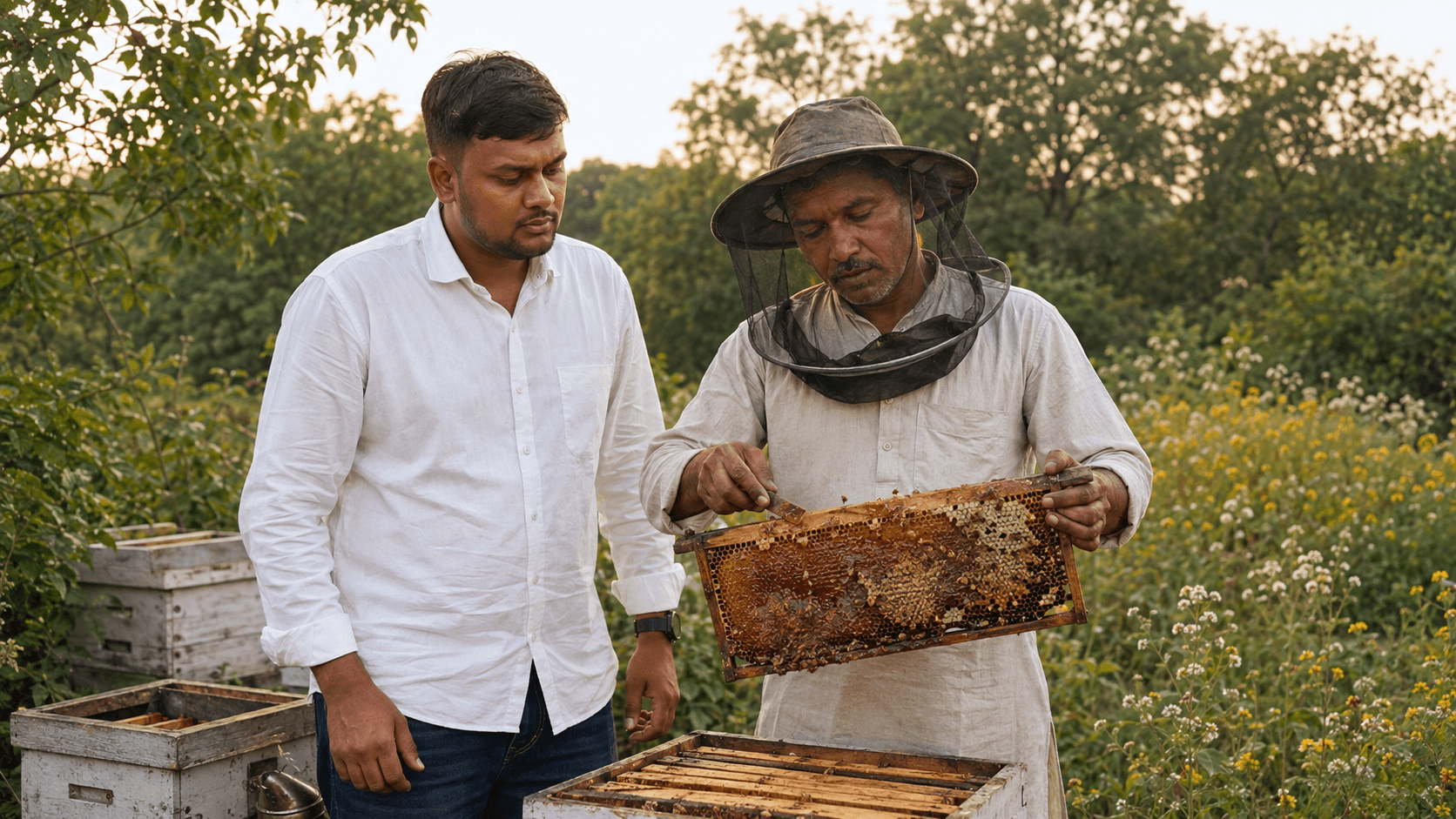
Our honey comes from our own managed beehives on our farm in Jaipur. Once harvested, it's only lightly filtered — enough to strain out physical bits like wax fragments — with nothing added at any stage: no sugar, no syrup. Because it isn't heavily processed, don't be surprised if it turns cloudy or partly crystallises in the jar after some time in storage, particularly in cooler months; that's a normal characteristic of raw honey, not a defect, and gently warming the jar (for instance, standing it in warm water) usually brings it back to a smoother, pourable texture. We don't publish lab certificates on our product pages today. If a matching batch or lab report exists for the specific jar you've ordered, we're happy to share it on request over WhatsApp — though we can't promise a report exists for every batch, and we won't claim one does when it doesn't.
So What Should You Actually Do If You Want Certainty?
If what you need is a definitive, lab-grade purity verdict, no home test — ours or anyone else's — is going to get you there; that's a job for an accredited food-testing laboratory, not a kitchen glass of water. What a home test can reasonably do is satisfy some curiosity, as a rough, informal check. Beyond that, it helps to judge a jar of honey by what you can actually verify about it: where it comes from, how (and how little) it's processed, and whether the seller is straightforward about both. That's the basis we'd rather be judged on — our own beehives, light filtering only, nothing added — instead of a purity claim we can't back up with a report we don't have.
- Where are the beehives, and are they managed by the seller directly or bought in from elsewhere?
- Is anything added during processing — sugar, syrup, extra heat treatment?
- Will the seller share a batch-specific lab report on request, if one exists?
- Does the seller explain honey crystallising as a normal, expected change — or treat it as something to hide?
Aapke Sawaal
Frequently Asked Questions
Can the water test alone confirm my honey is pure?
No. It can flag honey that's been diluted with a lot of plain water, but it isn't built to detect the sugar-syrup adulterants used in modern blending, so a jar can pass the water test and still not be pure honey.
Why did my raw honey turn cloudy or solid in the jar?
That's natural crystallisation, common in raw, lightly filtered honey, especially in cooler weather. It's generally a sign of minimal processing, not spoilage or contamination — though on its own it doesn't prove purity either.
Does Organic Jaipur Store's honey come with a lab-certified purity report?
We don't publish lab certificates on our product pages. If a matching batch report exists for the honey you've ordered, we can share it on request over WhatsApp, but we can't guarantee a report exists for every batch.
Is the flame test a reliable way to check honey at home?
It's a widely shared home test, but its result depends heavily on the honey's natural moisture content, which varies by floral source and storage — so it isn't considered a dependable purity indicator by itself, and it also carries an obvious fire-safety caution.
What actually makes Organic Jaipur Store's honey 'raw'?
It's harvested from our own managed beehives on our farm in Jaipur and only lightly filtered to remove physical impurities like wax — with no added sugar or syrup at any stage.
Shop Honey from Organic Jaipur Store
Shop Honey →