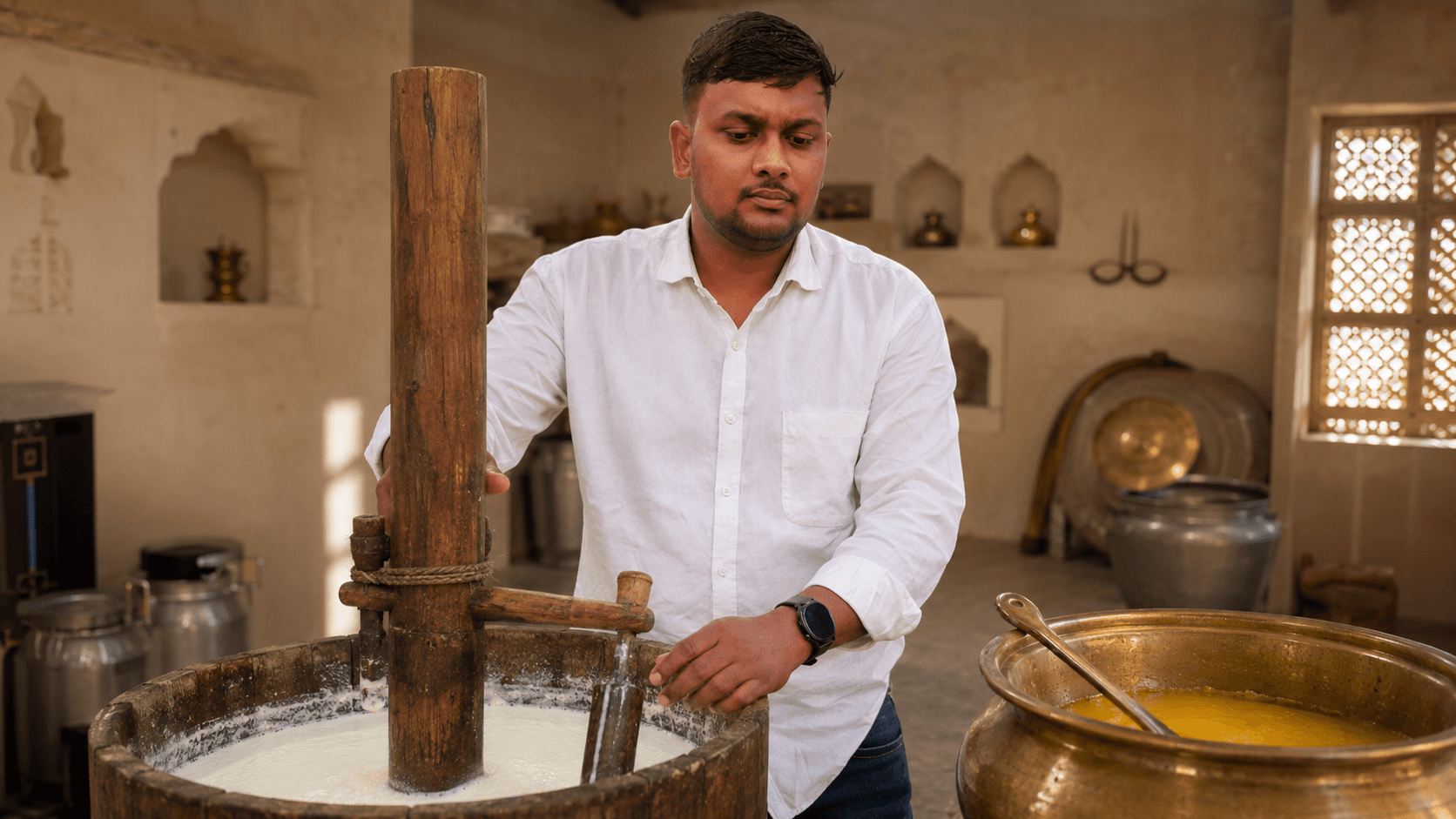
From Curd to Ghee, By Hand
Bilona Ghee Process Explained: How Our Farm Ghee Is Made Step by Step
The Bilona ghee process turns milk into ghee through four traditional stages: selecting Gir cow, Desi cow or buffalo milk, culturing it into curd overnight, hand-churning that curd with a wooden bilona to separate butter, and slow-cooking the butter into clear, golden ghee. Unlike a machine cream-separator method, which pulls cream directly from milk, every stage here is done manually and takes real time — no shortcuts, nothing added.
September 15, 2026 · Ghee
What Is the Bilona Method, Exactly?
Bilona simply refers to the traditional wooden churner used to separate butter from curd by hand. The "Bilona method" of making ghee is named after this tool, and it describes a specific sequence: milk is first turned into curd, the curd is churned to get butter, and that butter is then cooked down into ghee. This is different from starting with cream that has been mechanically separated from milk. It's a slower, more hands-on way of making ghee that has traditionally been followed in Indian homes for generations, and it's the process we follow on our own farm in Jaipur.
How Is Bilona Ghee Made? The Complete 4-Step Process
Here is exactly how we make our Bilona ghee, from milk to jar, in the order it actually happens.
- Step 1 — Milk Selection: We start by choosing the milk itself. Depending on the product, we use milk from Gir cows, Desi cows, or buffaloes raised on our own farm in Jaipur. The type of milk is decided upfront, because it shapes everything that follows — the curd, the butter, and finally the ghee.
- Step 2 — Curd Culturing: The selected milk is left to culture and rest naturally overnight, turning into curd (dahi). This isn't rushed or force-set — the milk needs undisturbed time to develop into proper curd, which is the actual starting point for Bilona ghee, unlike methods that go straight from milk to cream.
- Step 3 — Hand-Churning With a Wooden Bilona: The curd is churned by hand using a traditional wooden bilona (churner), worked slowly and steadily until butter (makkhan) separates from the buttermilk. This manual churning step is what gives the method its name, and it is fundamentally different from using a machine cream separator, which extracts cream directly from raw milk without ever making curd.
- Step 4 — Slow-Cooking Into Ghee: The fresh butter (makkhan) collected from churning is heated gradually on a slow flame. As it cooks, moisture evaporates and the butter transforms into clear, aromatic, golden ghee. Once it reaches the right stage, it is filtered and packed — with nothing added at any point in the process.
Why Does Each Traditional Step Matter?
Every stage in the Bilona process takes time, and that's by design, not an inefficiency. Culturing milk into curd overnight lets natural fermentation happen at its own pace — there is no way to skip straight from milk to butter without first passing through curd. Hand-churning that curd with a wooden bilona instead of a machine is slower and physically demanding, often taking hours of manual effort per batch, but it's how butter has traditionally been separated from curd in Indian kitchens for generations.
The final slow-cooking step matters just as much. Heating the butter gradually, instead of rushing it over high heat, gives moisture the time it needs to fully leave and lets the milk solids brown gently — this is what produces clear, deep-golden ghee with its characteristic aroma. A cream-separator machine method works differently from the very first step: it separates cream directly from milk using a mechanical separator, without any curd-culturing or hand-churning stage at all. That route is quicker and easier to scale, which is exactly why it's common among larger commercial ghee makers — but it is a genuinely different process, not simply a faster version of the same one.
Bilona Hand-Churned vs Cream-Separator Machine Ghee: Side by Side
Because the two methods start from different points and involve different amounts of manual work, they're worth comparing directly.
| Aspect | Bilona Hand-Churned Method (our process) | Cream-Separator Machine Method |
|---|---|---|
| Starting point | Milk is first cultured into curd overnight | Cream is separated directly from raw milk |
| How butter is separated | Curd is churned slowly by hand with a wooden bilona | A mechanical separator extracts cream, which is then processed by machine |
| Time taken per batch | Roughly a full day or more — overnight culturing, plus hours of hand-churning and slow-cooking | A matter of minutes to separate cream, with faster mechanical processing after |
| Effort involved | Manual, hands-on labour at the churning stage | Largely automated |
| Typical texture/aroma outcome* | Often described as having a more granular texture and a pronounced, roasted aroma | Often smoother in texture and milder in aroma |
Bilona hand-churned ghee vs cream-separator machine ghee
*These are general traits people commonly describe when comparing the two methods, not a claim about nutritional quality or health benefit — both are, at the end of the day, ghee made from milk fat.
Is "Homemade-Style" Ghee Just a Marketing Label? Common Misconceptions
It's a fair question. Words like "hand-churned" and "bilona" have become common on ghee packaging, so it's reasonable to wonder whether they describe anything real or are simply added for effect. The honest answer is that it depends entirely on whether the process behind the label actually happened.
For our own ghee, that means milk from our farm's Gir cows, Desi cows or buffaloes is rested into curd first, churned by hand with a wooden bilona, and only then slow-cooked into ghee — with no cream-separator shortcut and nothing added along the way. We should also be upfront that we don't currently publish lab certificates or third-party purity test reports on our product pages. If a batch-specific report happens to exist, we're happy to share it on request over WhatsApp, but we won't claim a certification or test result we don't actually have. What we can stand behind, and what you can genuinely verify by asking us, is the process itself — the real, procedural difference between Bilona ghee and ghee made by cream separation.
What Does "A2 Ghee" Mean for Our Gir Cow and Desi Cow Milk?
You may see ghee made from indigenous cow breeds like Gir and Desi cow marketed as "A2 ghee." The term refers to the type of milk these breeds are commonly associated with, as distinct from milk from certain other cattle breeds. On our farm, milk from Gir cows and Desi cows is used to make this style of ghee, while our buffalo milk ghee is offered separately as its own product. We're describing this as a matter of breed and milk source, not as a health or medical claim, and we'd encourage you to look into the underlying topic independently, and to treat any specific health-benefit claim you come across elsewhere with a healthy dose of scepticism unless it comes from a source you trust.
How to Get Bilona Ghee From Our Farm to Your Door
Once a batch is ready, ordering is straightforward. You can add it to your cart on our website and check out directly, or place an order over WhatsApp using the pre-filled message available on each product page — whichever works better for you. Payment can be made via Cash on Delivery or online through Razorpay. Within Jaipur city, our own team hand-delivers orders to your doorstep at no charge, rather than handing them off to a third-party courier. For addresses elsewhere in Rajasthan, including Jodhpur, Udaipur and Kota, we ship by courier, with weight-based charges between ₹59 and ₹199 on orders under ₹1,499, and free shipping (up to 3 kg) on orders of ₹1,499 and above. Once your order is placed, you can track it any time using your order number and phone number on our Track Order page.
Aapke Sawaal
Frequently Asked Questions
How long does it take to make Bilona ghee?
A single batch typically takes roughly a day or more from start to finish — the milk first needs to culture into curd overnight, then it's hand-churned for hours with a wooden bilona, and finally slow-cooked into ghee. This is considerably longer than a cream-separator machine method, where cream can be separated from milk in a matter of minutes.
What milk is used for Bilona ghee?
We use milk from Gir cows, Desi cows or buffaloes raised on our own farm in Jaipur, with the type selected per product.
Is Bilona ghee the same as regular ghee?
Both are ghee made from milk fat, but the process differs. Bilona ghee is made by first culturing milk into curd, then hand-churning that curd into butter with a wooden churner before slow-cooking it into ghee. Many commercial ghee makers instead use a cream separator to pull cream directly from milk, skipping the curd-culturing and hand-churning stages.
Does this ghee come with a lab certificate or purity test report?
We don't publish lab certificates or purity test reports on our product pages. If a batch-specific report happens to exist, we can share it on request over WhatsApp, though we can't guarantee one exists for every batch.
Can I track my ghee order after I place it?
Yes. Once your order is placed, you can track it on our Track Order page using your order number and the phone number you ordered with.
Shop Ghee from Organic Jaipur Store
Shop Ghee →