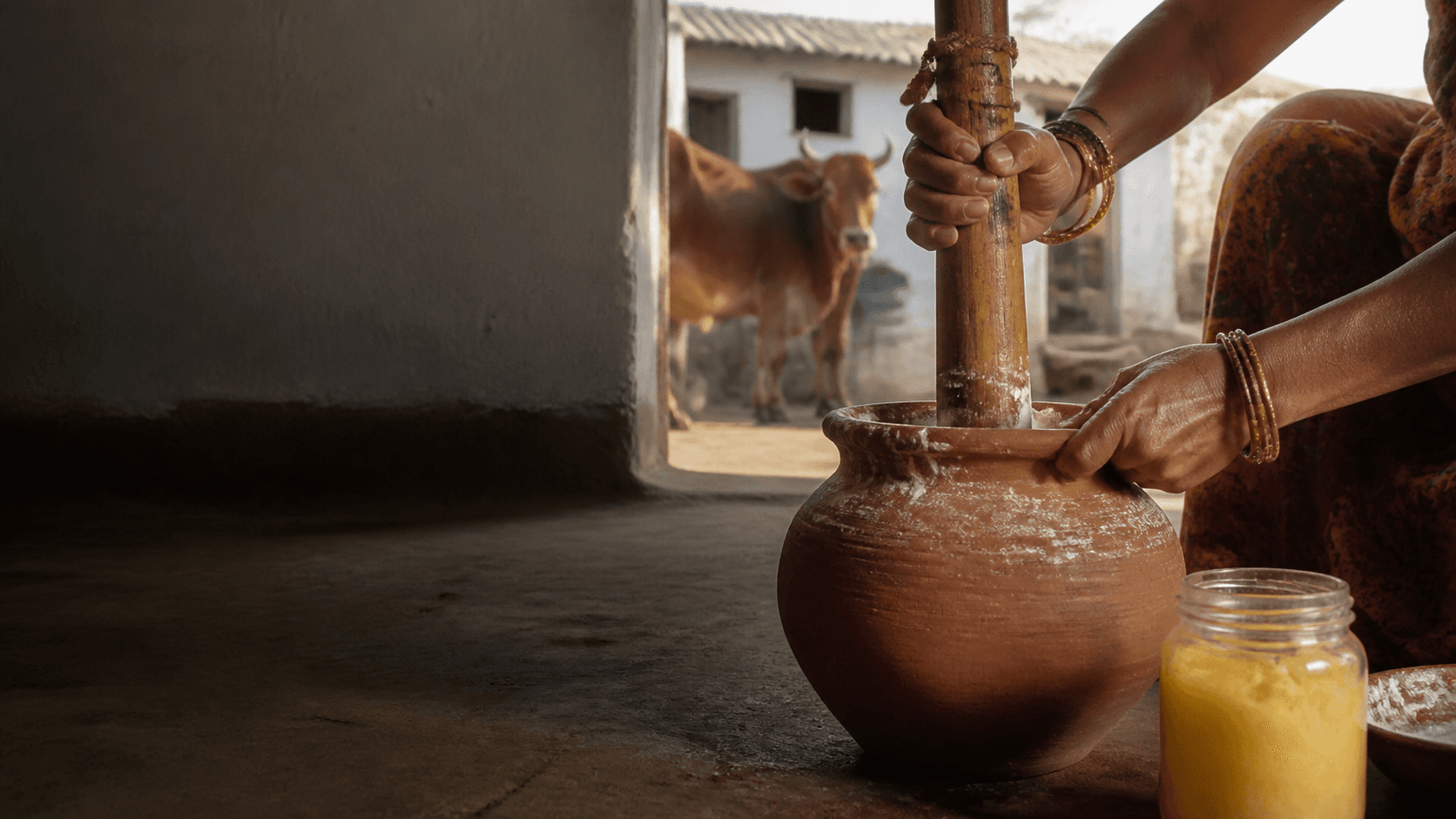
A2 Ghee vs Regular Ghee, Explained
A2 Ghee vs Regular Ghee: Which One Should You Choose?
A2 ghee is made from the milk of cow breeds that naturally produce mostly A2 beta-casein protein, such as Gir and other desi cows, while "regular" ghee is usually made from mixed or unspecified milk sources without that distinction. In practice, though, the bigger everyday difference is often the process behind the jar - which is exactly where our own hand-churned, bilona-made ghee sets itself apart from most regular commercial ghee.
September 17, 2026 · Ghee
What Does "A2 Ghee" Actually Mean?
The "A2" in A2 ghee refers to A2 beta-casein, a type of protein found in cow milk. Indigenous Indian cattle breeds - Gir cows and other desi cow breeds among them - are known to naturally produce milk that is predominantly A2 type. On our own farm in Jaipur, we keep Gir cows and desi cows specifically for their milk, and that milk is what goes into our A2 ghee. It's worth being clear that this is a description of the cow's breed and milk protein type, not a certification, a lab result, or a medical claim - we're simply telling you where the milk comes from.
What Is A1 or "Regular" Ghee, Then?
Most ghee sold under generic or unbranded "regular" labels doesn't specify which protein type its milk contains. It's commonly made from milk pooled across mixed or crossbred cattle herds, which can include cows carrying the A1 beta-casein variant alongside A2. It's also worth noting that the A1/A2 conversation is specific to cow milk - buffalo milk has its own distinct protein profile and isn't really part of that same distinction, which is why we treat our buffalo ghee as its own product rather than labelling it "A2." Beyond the milk protein itself, regular commercial ghee is also usually produced differently at the manufacturing stage, and that difference in process is often what buyers actually notice in taste, aroma and texture.
How Is Our A2 Ghee Actually Made? (The Bilona Process)
Most regular commercial ghee is made by separating cream directly from milk with a machine, then heating that cream into ghee - a fast, scalable method that skips a traditional step entirely. We make ours the older, slower way, known as the bilona method:
- Milk from Gir cow, desi cow or buffalo is selected, depending on the product.
- The milk is cultured and left to rest naturally into curd overnight.
- The curd is hand-churned slowly with a wooden bilona (churner) to separate the butter, or makkhan - the step that machine cream-separation skips altogether.
- The makkhan is then heated gradually and slow-cooked until the moisture leaves it and it turns into clear, golden, aromatic ghee, which is filtered and packed.
Nothing is added at any stage, and there is no cream-separator shortcut in between. This takes considerably more time and labour per litre than machine separation, which is also part of why hand-churned bilona ghee typically costs more than mass-produced ghee - a matter of process and effort, not a lab claim.
Bilona A2 Ghee vs Regular Commercial Ghee: A Side-by-Side Comparison
Here is how the two generally compare, step by step. Individual brands and products can of course vary from this general picture.
| What You're Comparing | Our Bilona A2 Ghee (Gir Cow / Desi Cow / Buffalo) | Typical Regular Commercial Ghee |
|---|---|---|
| Milk source | Our own farm's Gir cow, desi cow or buffalo milk, selected per product | Often pooled milk from multiple, mixed or crossbred herds |
| Butter extraction | Curd is hand-churned in a wooden bilona to separate makkhan (butter) | Cream is separated directly from milk by machine, skipping the curd-churning step |
| Turning into ghee | Makkhan is slow-cooked gradually until it becomes clear, aromatic ghee | Cream or butter is usually heated in larger batches for faster throughput |
| Batch size | Small batches, tied to what our own farm produces day to day | Usually large-volume batches made for wide retail distribution |
| Traceability | Milk we source ourselves, on our own farm in Jaipur | Milk typically aggregated from many unnamed dairy sources before processing |
| Price positioning | Reflects the labour-intensive hand process and smaller scale | Reflects lower per-unit cost from mechanised, large-scale processing |
A general comparison of process and positioning - not a claim that one is medically superior to the other.
Does A2 Ghee Have Extra Health Benefits Over Regular Ghee?
We'd rather be direct here: we have no clinical studies or lab data to back specific health claims, and we won't make any. What we can honestly say is that in Ayurvedic tradition and everyday Indian households, ghee made from indigenous cow milk and slow bilona-churning has long been considered easier on digestion and gentler by many people, with desi cow milk in particular often spoken of this way in traditional practice. That is a matter of tradition and personal experience, not a medical guarantee, and it can vary from person to person. If you're choosing between A2 and regular ghee for a specific health reason, it's worth speaking with a doctor or nutritionist rather than relying on any brand's packaging claims - ours included.
So, How Should You Decide Which Ghee to Buy?
There's no single right answer here - it comes down to what matters most to you as a buyer.
- How the milk becomes ghee: choose hand-churned bilona ghee if you value the traditional slow process, or regular cream-separated ghee if speed and a lower price matter more.
- Where the milk comes from: we can tell you ours is from our own farm's Gir cows, desi cows and buffaloes in Jaipur - it's worth asking any brand you're considering the same question.
- Cow ghee vs buffalo ghee: our cow ghee (Gir or desi) tends to be lighter in colour with a more delicate aroma, while our buffalo ghee is richer and creamier - both are valid choices, and it comes down to taste.
- Budget and quantity: hand-churned, small-batch ghee generally costs more per kilo than large-batch commercial ghee, reflecting the process and scale rather than any claim of one being medically better.
- How much proof you personally need: if a published lab certificate matters to you, ask any brand directly what they can show you - including us; we're upfront that we don't publish these on our product pages.
Ordering and Delivery, If You Choose Ours
If you'd like to try our bilona A2 ghee, you can order through the website cart or send a WhatsApp order using the pre-filled message on any product page, paying by Cash on Delivery or Razorpay online payment. If you're in Jaipur, our own team hand-delivers your order to your doorstep - it isn't handed off to a third-party courier - and this delivery is free. Elsewhere in Rajasthan, including Jodhpur, Udaipur and Kota, we ship by courier: weight-based charges of ₹59 to ₹199 apply on orders under ₹1,499, and delivery is free (up to 3kg) on orders of ₹1,499 or more. You can track any order on our Track Order page using your order number and phone number.
Aapke Sawaal
Frequently Asked Questions
Is A2 ghee better than regular ghee for health?
We can't say it's medically superior, and we won't claim that - there's no clinical data we can point to. A2 milk and bilona-made ghee have a long-standing place in Ayurvedic tradition, and many people believe it suits them better, but that's tradition and personal experience, not a proven health claim. It's worth choosing based on process, source and taste preference rather than an expected health outcome.
Do you make cow ghee or buffalo ghee, and is your buffalo ghee also "A2"?
We make ghee from Gir cow, desi cow and buffalo milk, all using the same bilona hand-churned process. The A1/A2 distinction is specific to cow milk protein, so we don't label our buffalo ghee as "A2" - buffalo milk has its own distinct protein profile. If you specifically want cow-milk A2 ghee, choose our Gir cow or desi cow ghee.
Can I see a lab report or certification backing your A2 claim?
We don't publish lab certificates or purity reports on our product pages. If you'd like to check for a specific batch, message us on WhatsApp and we'll share a matching report if one genuinely exists for that batch - we won't tell you one exists otherwise.
Why does bilona A2 ghee cost more than regular ghee in stores?
Hand-churning butter from curd in a wooden bilona, then slow-cooking it into ghee, takes far more time and labour per batch than the machine cream-separation used for most regular commercial ghee. The price difference reflects that process and our smaller, farm-based batch sizes - it isn't a claim that one ghee is medically better than the other.
How do I order your A2 ghee, and what are the delivery options?
You can order through our website cart or via WhatsApp using the pre-filled message on any product page, and pay by Cash on Delivery or Razorpay. Within Jaipur, our own team hand-delivers for free. Elsewhere in Rajasthan, including Jodhpur, Udaipur and Kota, delivery is by courier - ₹59 to ₹199 on orders under ₹1,499, and free (up to 3kg) on orders of ₹1,499 or more. You can track any order using your order number and phone number on the Track Order page.
Shop Ghee from Organic Jaipur Store
Shop Ghee →